Universitas Andalas - Research Directory

 UNIVERSITAS ANDALAS
  Penelitian Dosen Pemula
  Rp 29.200.000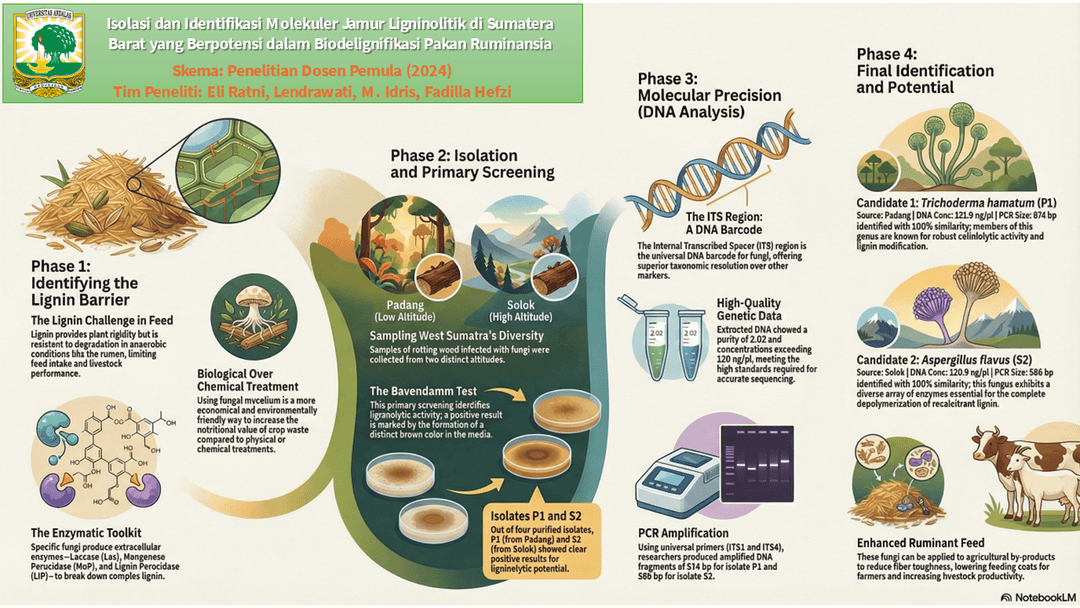
Two of four purified fungal isolates (P1 and S2) showed positive results in the Bavendamm test, indicating their ligninolytic potential. PCR amplification produced 574 bp (P1) fragments and 586 bp (S2). BLAST analysis identified P1 as Trichoderma hamatum and S2 as Aspergillus flavus with 100% similarity. Identifying T. hamatum and A. flavus as ligninolytic fungi from West Sumatra provides valuable insight for applying these species in animal production technology. These fungi could contribute in biodelignification processes, improving the utilization of lignocellulosic waste as a ruminant feed source. This study represents the first molecular identification of ligninolytic fungi isolated from decayed wood in West Sumatra, Indonesia, utilizing the Internal Transcribed Spacer (ITS) region. The research successfully identified Trichoderma hamatum and Aspergillus flavus as local lignin-degrading fungal species, which have not been previously reported in this region for this particular application. These findings underscore the untapped potential of indigenous fungal biodiversity in the biodelignification of lignocellulosic agricultural waste. Additionally, the study confirms the effectiveness of the Bavendamm test as a preliminary screening tool for ligninolytic fungi prior to molecular identification. This research contributes valuable genetic and functional data towards developing sustainable ruminant feed strategies.
Identifying T. hamatum and A. flavus as ligninolytic fungi from West Sumatra provides valuable insight for applying these species in animal production technology. These fungi could contribute in biodelignification processes, improving the utilization of lignocellulosic waste as a ruminant feed source.