Universitas Andalas - Research Directory


 UNIVERSITAS ANDALAS
  Penelitian Unggulan Jalur Kepakaran
  Rp 98.400.000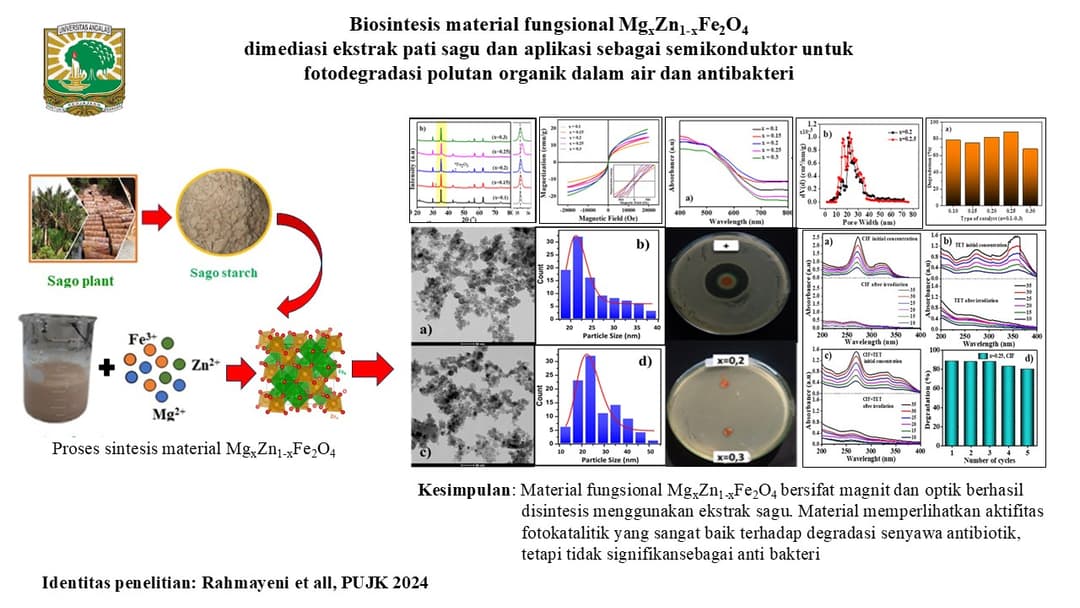
Mg-doped ZnFe₂O₄ spinel ferrite nanoparticles (MgxZn1-xFe2O4, x = 0.1–0.3) were synthesized via a sago-starch-assisted sol–gel autocombustion method and evaluated for solar-driven photocatalytic degradation of ciprofloxacin and tetracycline antibiotics. Comprehensive characterization using XRD, FTIR, Raman spectroscopy, TGA, SEM-EDS, TEM, VSM, UV–Vis DRS, and BET confirmed the formation of single-phase spinel structures with tunable physicochemical properties. The materials exhibited superparamagnetic behavior with saturation magnetization values of 11.9–19.6 emu g⁻¹, enabling facile magnetic recovery. Optical analysis revealed visible-light absorption with band gap energies in the range of 1.45–1.67 eV. Morphological observations by SEM and TEM revealed relatively uniform nanoparticles with sizes ranging from 15 to 45 nm. Among the compositions, MgxZn1-xFe2O4demonstrated superior photocatalytic performance, achieving about 85% degradation of ciprofloxacin and 70% of tetracycline within 120 min under solar irradiation. The enhanced activity is attributed to the synergistic effects of reduced crystallite size, increased surface area, and improved charge separation, which facilitate reactive oxygen species generation. The integration of Mg substitution with a sago-starch-mediated green synthesis route offers an environmentally benign approach to producing efficient, magnetically recoverable photocatalysts. These findings highlight the potential of Mg-modified ZnFe2O4 for sustainable treatment of antibiotic-contaminated wastewater.x=0.25 and 2 hours.
Material berpotensi sebagai katalis dalam menghilangkan bahan-bahan antibiotik dalam air yang digerakan oleh cahaya