Universitas Andalas - Research Directory


 UNIVERSITAS ANDALAS
  Penelitian Disertasi Doktor
 Rp 42.000.000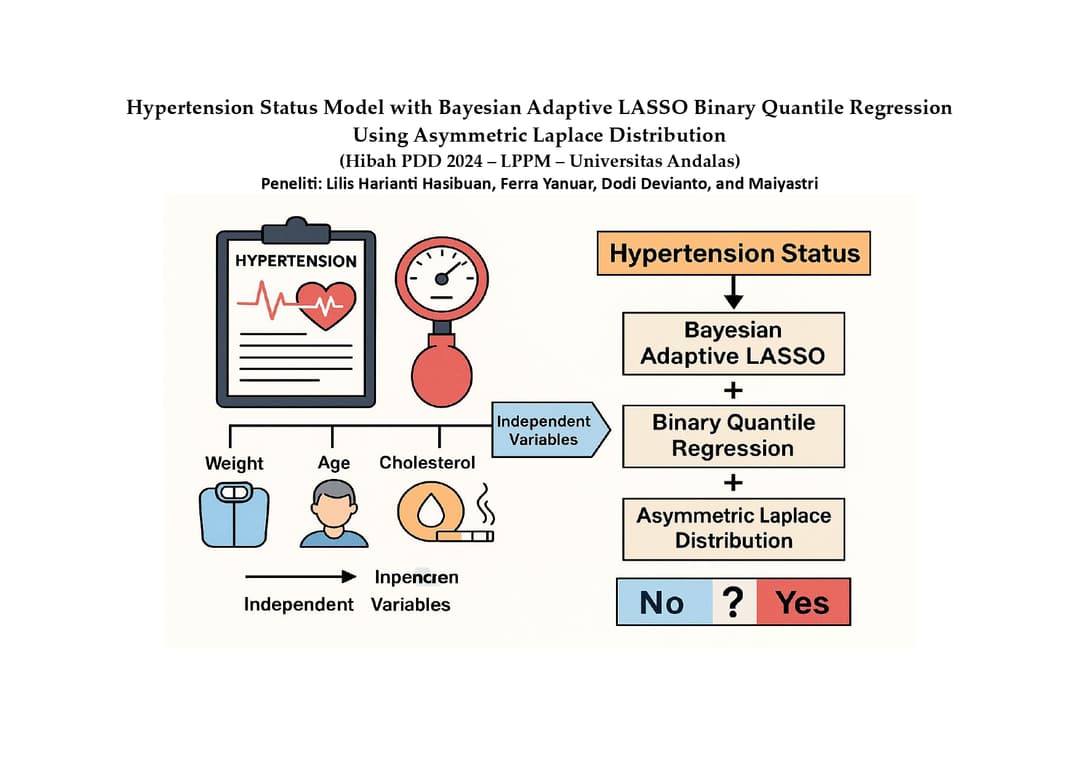
Binary quantile regression has become popular in the last decade due to its robustness against outliers and its ability to detail the effects of independent variables on binary outcomes. This study applied a Bayesian hybrid approach combining binary quantile regression, LASSO, and adaptive LASSO with errors following the Asymmetric Laplace Distribution. The model was used to analyze hypertension status data from 635 patients at Arosuka Solok Hospital, West Sumatra, Indonesia. Results showed that the Bayesian Adaptive LASSO Binary Quantile Regression outperformed other models by producing the smallest Mean Square Error (MSE). At quantile 0.05, age, weight, cholesterol, smoking, triglycerides, and blood sugar levels significantly influenced hypertension risk. Specifically, a 1-year increase in age raised the risk 2.36 times; a 1 kg weight gain increased it by 2.046 times; a 1 mg/dL rise in cholesterol by 1.289 times; triglyceride by 1.150 times; and blood sugar by 1.633 times. In conclusion, the Bayesian Adaptive LASSO Binary Quantile Regression method provides the most accurate and efficient model for predicting hypertension status among the tested approaches.
Bermanfaat untuk pengembangan ilmu statistika dan bidang kesehatan