Universitas Andalas - Research Directory

 UNIVERSITAS ANDALAS
  Penelitian Disertasi Doktor
 Rp 49.000.000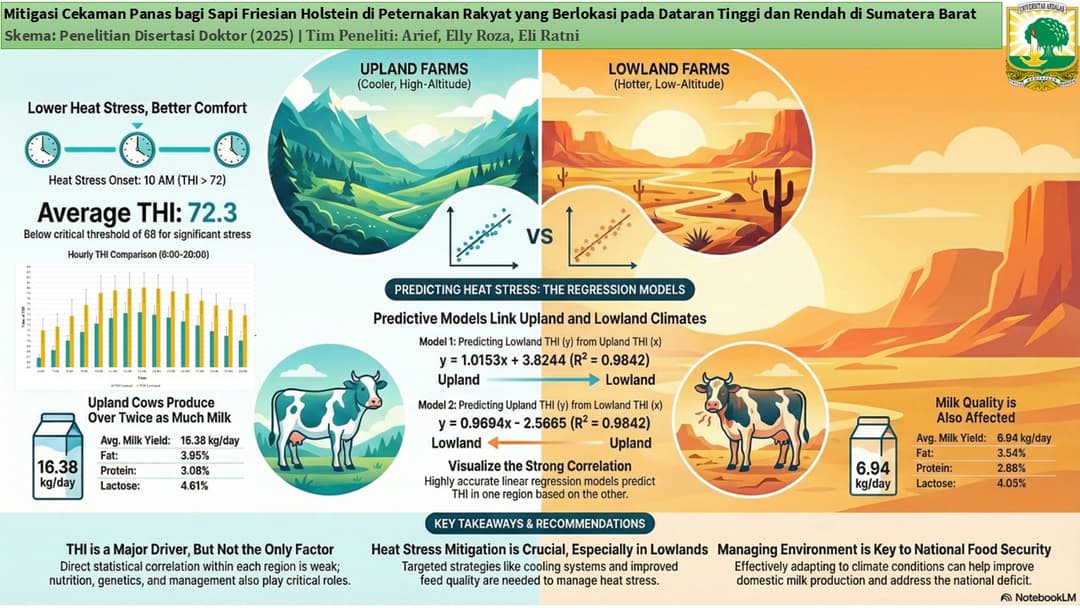
This study aims to develop regression models for the Temperature-Humidity Index (THI) and assess its impact on milk yield in Upland and Lowland dairy farms in West Sumatra, Indonesia. The research examines the relationship between THI and milk production, comparing dairy cattle productivity in regions with varying climatic conditions. THI data were collected from Upland and Lowland farms, and daily milk production records were analyzed. Linear regression models were developed to predict THI values, and correlation analysis was used to assess the strength of the relationship. In sequence, these are y = 1.0153x + 3.8244 and y = 0.9694x – 2.5665, with an r value close to 1. The results indicate that Upland farms, with lower THI, had higher milk yields (16.38 kg/cow/day), compared to Lowland farms, where THI was higher and milk production was lower (6.94 kg/cow/day). The regression models suggested a minimal effect of THI on milk production due to other influencing factors. The study highlights the importance of environmental management to mitigate heat stress, especially in Lowland areas, and recommends strategies for improving dairy cattle productivity. The findings contribute to understanding the climatic factors in dairy farming and provide insights for future research and policymaking in livestock management.
Penelitian ini menegaskan pentingnya pemantauan parameter fisiologis dan profil darah ternak untuk mengoptimalkan kesejahteraan dan produktivitas sapi perah dalam menghadapi cekaman panas. Dengan strategi mitigasi yang tepat, peternakan dapat meningkatkan kesehatan dan hasil produksi susu sapi Friesian Holstein di lingkungan yang berisiko tinggi terhadap stres panas.